 English
 French
 German
 Italian
 Portuguese
 Spanish
When Light Becomes Architecture’s Fourth Dimension
For architects and designers, light is more than illumination—it becomes architecture’s fourth dimension, an invisible material that shapes form and evokes emotion. Picture a modern villa at dusk: through a refined interplay of light and shadow, its façade transforms. Lines stretch, textures deepen, and an ordinary structure becomes a work of art.
In real-world projects, however, designers often face persistent challenges. Traditional outdoor lighting requires complex wiring, which compromises façade integrity and results in high energy costs and continual maintenance. In high-end residential or commercial projects, these issues often hinder the execution of design intent.
Fortunately, Sottlot’s professional solar wall light series offers an ideal solution. These products feature zero-wiring installation and run entirely on solar energy, ensuring zero electricity costs. They also incorporate an advanced adaptive lighting system that automatically adjusts brightness via PIR (passive infrared) sensors. This system intelligently responds to ambient conditions and human activity, ensuring energy efficiency, reliability, and durability. As a subsidiary of SRESKY, Sottlot has specialized in solar lighting R&D since 2004, delivering proven stability and innovation across more than 70 countries and regions.
Creative Concept 1: Creating Rhythm and Order with Narrow Beam Lighting
Design Philosophy
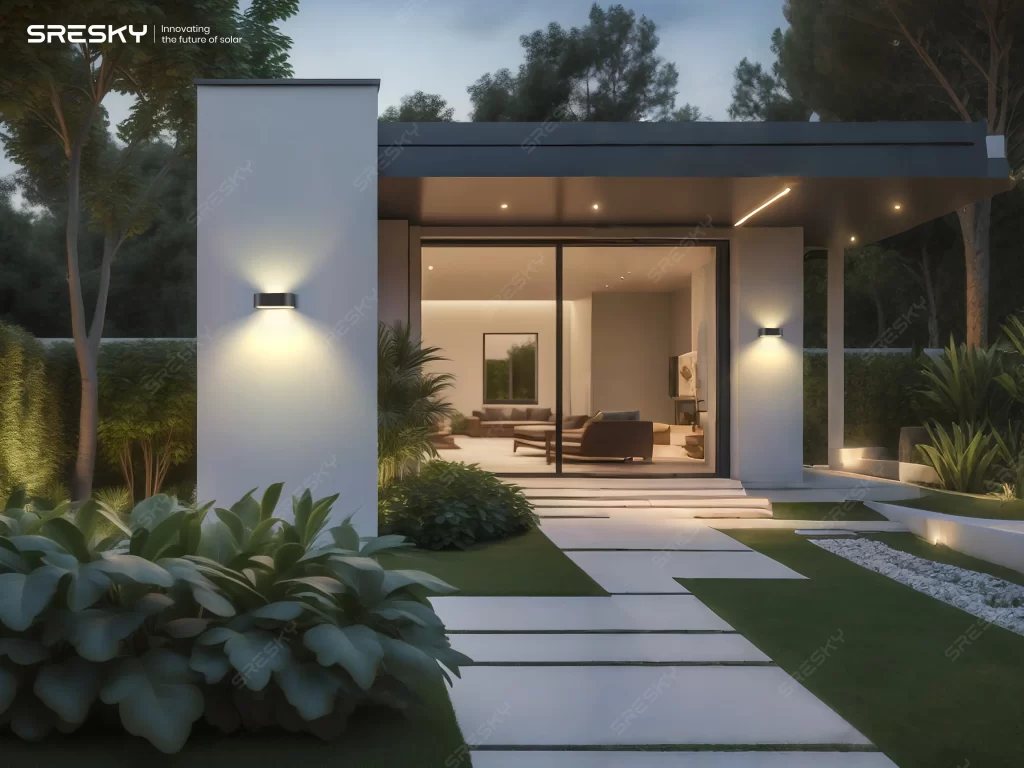
In architectural design, rhythm and order are essential for achieving visual harmony. By spacing wall lights evenly and projecting repeated “light columns” onto façades with narrow beams, designers create strong linear guidance. Similar to musical rhythm, this approach directs attention and enhances structural depth. It is ideal for minimalist façades, long corridor exteriors, and fence posts in high-end villas or commercial complexes—bringing a disciplined yet elegant contemporary aesthetic.
For example, installing narrow-beam fixtures every 2 meters along a 20-meter perimeter wall creates a continuous “light grid.” Upward beams highlight rooflines, while downward beams illuminate pathways. This enhances safety and gives the structure sculptural depth without the glare and clutter typical of floodlights.
Sottlot Recommendations: MESA ESL-83 & CUBE SWL-32
The MESA ESL-83 and CUBE SWL-32 are ideal for this concept. Both feature a 23° narrow lens, delivering focused beams with minimal spill for precise light control.
The MESA ESL-83 offers 700 lm at 4000K (Ra >70), IP65 waterproofing, a recommended installation height of 2.5 m, and durable ABS & PC construction. The CUBE SWL-32 also outputs 700 lm, with IP54 protection and versatile materials suitable for various outdoor settings. Their controlled 23° beams provide sufficient brightness while minimizing light spill—achieving true “precision lighting,” aligned with sustainable design principles.
For B2B clients such as contractors or construction firms, reliability is crucial. These solar lamps use monocrystalline silicon panels and lithium-ion batteries for high charging efficiency, ensuring stable illumination even during cloudy or rainy weather. Four lighting modes allow customization—for example, constant lighting for displays or sensor modes for energy savings.
Creative Concept 2: Enhancing Material Texture with Wide Beam Lighting
Design Concept
Material textures are essential to architectural identity, yet often subdued in natural daylight. Wide-beam illumination “washes” façades from above and below, accentuating surface details such as cultural stone, wood grain, or brushed metal. This interplay of light and shadow adds depth and vitality—ideal for historic renovations, boutique hotels, or premium residential projects.
For instance, on a textured stone wall, upward-facing wide beams highlight rugged contours, while downward illumination creates soft shadow transitions. Designers can adjust color temperature to influence mood—3000K for warm residential tones, 4000K for a sleek modern appearance.
Sottlot Tool Recommendation: MITER SWL-31
The MITER SWL-31 is ideal for wide-beam applications. Its 120° lens provides broad, soft coverage.
Technical details include 700 lm output, 4000K color temperature, Ra >70, IP44 waterproofing, a 2.5 m mounting height, and ABS & PC construction. Its wide distribution ensures comfortable, uniform illumination without glare. For B2B needs, four smart lighting modes allow balancing aesthetics with energy efficiency. Multiple mounting options—screws, cable ties, or horizontal bars—enhance flexibility for complex façades.
Creative Concept 3: Twin Beams—Double the Visual Impact
Design Concept
For large architectural volumes or heightened visual drama, single beams may feel insufficient. The “Twin Beams” concept uses paired light sources to create fuller illumination and stronger impact—ideal for villa façades, commercial columns, or hotel entrances.
For example, installing Twin Beam fixtures at a hotel entrance produces a symmetrical “light curtain,” emphasizing vertical height while illuminating pathways and enhancing grandeur.
Sottlot Tool Recommendation: CUBE SWL-33
The flagship CUBE SWL-33 features a Twin Beam design with a total brightness of 1400 lm.
It uses a 23° narrow beam, 4000K color temperature, Ra >70, IP54 protection, and ABS & PC & PS materials. The dual-beam layout produces a more commanding presence than the single-beam CUBE SWL-32. Think of the SWL-32 as a single elegant stroke, while the SWL-33 performs a dual-beam symphony—doubling the drama.
Creative Concept 4: Framing—Defining Entrances and Boundaries
Design Philosophy
Framing uses symmetrical wall lights to emphasize entrances—doorways, garage doors, or windows. Vertical beams visually “lift” the space, enhancing prestige and curb appeal. This technique is ideal for luxury homes and boutique hotels.
Light verticality draws the eye upward, making entrances appear taller and more refined.
Sottlot Recommendations: MITER SWL-31 (Soft Framing) & MESA ESL-83 (Sharp Framing)
-
MITER SWL-31 (120°) creates a soft, welcoming “light gate.”
-
MESA ESL-83 (23°) offers a sharper, more contemporary “light edge.”
Both deliver 700 lm and offer four modes. For B2B clients, this simple framing strategy significantly enhances property appeal, while IP65/IP44 protection ensures long-term performance.
Creative Concept 5: Light-Shadow Interaction—A Dialogue with Architecture and Landscape
Design Philosophy
Light and shadow should extend beyond flat walls. Installing lights beneath beams or on column sides allows upward beams to illuminate eaves and downward beams to interact with landscaping—creating layered, dynamic environments.
Sottlot Solution
Made from ABS & PC or aluminum, Sottlot products offer durability and flexibility for complex installations. Their four-mode adaptive lighting system integrates seamlessly with smart solar garden lights, balancing aesthetics, safety, and efficiency.
Beyond Aesthetics: Why Designers and Architects Choose Sottlot Solar Solutions
Zero-Wiring Design Freedom
The zero-wiring design preserves building integrity, ideal for both historic structures and new developments.
Long-Term Reliability & Low TCO
Since 2004, Sottlot (under SRESKY) has focused on solar technology, using monocrystalline panels and Li-ion batteries to ensure longevity and low maintenance—significantly reducing total cost of ownership.
Smart & Sustainable Branding
Adopting solar lighting strengthens sustainable project identity and elevates brand value.
Conclusion: Illuminate Your Next Masterpiece with Sottlot
Up-and-down solar wall lights remain timeless solutions in architectural lighting. Sottlot provides designers with the ideal tools—advanced solar technology, precise optical engineering (23° & 120°), and proven durability—to illuminate architectural vision with creativity and confidence